
Mom Burnout, Anxiety, or Depression? How to Tell the Difference and When to Get Help
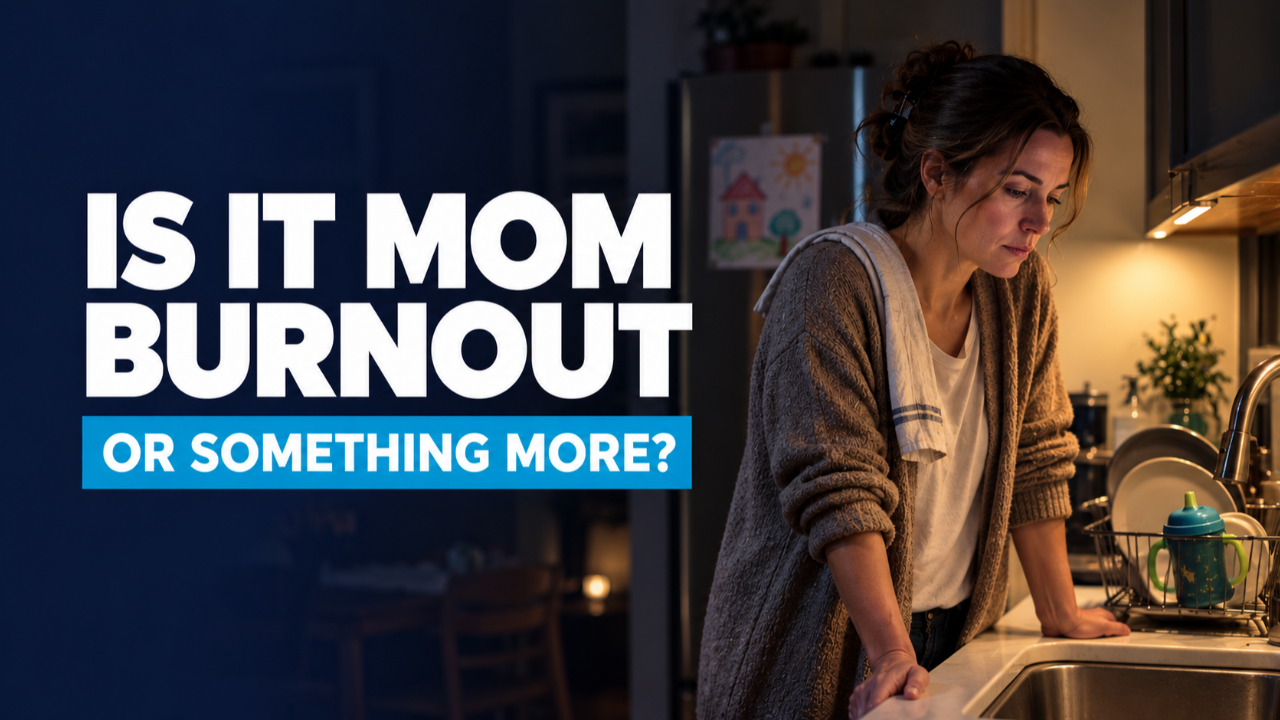
Sep 25, 2026It’s 9:47 p.m. The kids are finally asleep, the dishes are done (or done enough), and you’re sitting in the car in the driveway because it’s the only place nobody needs anything from you. You love your family. So why do you feel like this? Is it mom burnout, or is something more going on?
Maybe you snapped at your four-year-old over a spilled cup, then cried in the pantry. Maybe your mind won’t shut off at night, replaying pickups, permission slips, and the email you forgot to send. Maybe you’ve typed “why am I so tired all the time” into your phone more than once this month.
You tell yourself you’re just a tired mom. Everyone’s tired. But the question underneath deserves a real answer, not a pep talk.
Below, we’ll untangle everyday stress, mom burnout, anxiety, and depression, show you when it’s time to talk with a licensed professional, and share simple, research-backed tools, including self-hypnosis, for everyday stress and motivation.
You Are Not the Only One Running on Empty
If you feel stretched thin, you have plenty of company. In 2024, the U.S. Surgeon General issued a formal advisory on parental stress. It found that 48 percent of parents say most days their stress is completely overwhelming, compared with 26 percent of other adults, and 41 percent say most days they’re too stressed to function.
Moms in their early 30s often juggle little ones, a career or a full-time household, and very little sleep. Researchers at the University of Bath and the University of Melbourne surveyed 3,000 U.S. parents and found that mothers carry about 71 percent of household mental load tasks (the invisible planning, scheduling, and remembering), compared with 45 percent for fathers.
There’s even a name for the identity shift that comes with it: matrescence. Coined by anthropologist Dana Raphael in the 1970s and revived by Columbia University psychologist Dr. Aurélie Athan, it describes becoming a mother as a developmental passage much like adolescence. If you’re still figuring out who you are now, that isn’t a flaw. It’s a season.
Even Jesus noticed when His disciples were running on empty. So many people were coming and going that “they had no leisure so much as to eat,” and He told them, “Come ye yourselves apart into a desert place, and rest a while” (Mark 6:31, KJV). Rest wasn’t a reward. It was an invitation.
Stress vs. Anxiety: When Everyday Worry Becomes Something More
Stress is your body’s response to a real demand in front of you: a sick toddler, a deadline, a tight month. It usually rises and falls with the situation. When the fever breaks, you exhale.
Anxiety tends to stay switched on after things calm down, often attaching to what hasn’t happened yet. You check on the baby again after you know she’s fine. You lie awake running worst-case scenarios.
The National Institute of Mental Health (NIMH) describes generalized anxiety disorder as excessive, hard-to-control worry about everyday things, more days than not, for at least six months. Common signs include restlessness, tiring easily, trouble concentrating, irritability, muscle tension, and sleep problems. Anxiety disorders are also more common in women: NIMH data show a past-year rate of 23.4 percent for women versus 14.3 percent for men.
High-functioning anxiety isn’t a clinical diagnosis, but it describes something real: the mom who looks organized and capable while her mind never stops bracing for the next problem. Looking fine on the outside doesn’t mean you’re fine on the inside.
Mom Burnout vs. Depression: Tired, or Something Deeper?
Mom burnout is real, and researchers study it under the name parental burnout. Psychologists Isabelle Roskam and Moïra Mikolajczak describe four hallmarks: emotional exhaustion tied to parenting, emotional distance from your children, a loss of fulfillment in parenting, and a painful contrast between the mom you used to be and the mom you feel like now.
Depression overlaps with burnout, but it’s broader and heavier. According to NIMH, symptoms show up most of the day, nearly every day, for at least two weeks. They can include a sad, anxious, or “empty” mood; loss of interest in things you used to enjoy; changes in sleep or appetite; fatigue; guilt or worthlessness; irritability; and thoughts of death or suicide. In 2021, 10.3 percent of U.S. women had a major depressive episode, compared with 6.2 percent of men.
A simple way to notice the difference: burnout centers on the parenting load and often eases with genuine rest and real help. Depression tends to color everything, including the things you used to love, and a weekend away doesn’t lift it.
Then there’s so-called high-functioning depression, an informal term for living with depressive symptoms while still keeping up with work, school runs, and church responsibilities. It often overlaps with persistent depressive disorder, a lower-grade depression lasting two years or longer. Holding it all together is not the same as being well.
The Difference Between Stress, Burnout, Anxiety, and Depression at a Glance
|
|
What it can feel like |
Typical timeline |
When to talk to a professional |
|
Everyday stress |
Pressure tied to a demand you can name |
Rises and falls with the situation |
If it doesn’t ease once the demand passes |
|
Mom burnout |
Drained, emotionally distant, parenting on autopilot |
Builds over months of overload |
If rest doesn’t restore you, or you feel detached from your kids |
|
Anxiety |
Worry or dread that’s hard to control |
Most days, for months |
If worry disrupts sleep, work, parenting, or relationships |
|
Depression |
Heaviness, emptiness, or loss of interest and joy |
Most of the day, nearly every day, for 2+ weeks |
As soon as you notice it, and right away if you have thoughts of self-harm |
These often overlap. You can be burned out and anxious at the same time, and the Anxiety and Depression Association of America notes that about half of people diagnosed with depression also have an anxiety disorder.
Mom Rage and Postpartum Rage: When Anger Is a Signal
Few things carry more shame for moms than rage. You love your children fiercely, yet some days the whining, the mess, and the constant touching make you want to scream. Sometimes you do. Then comes the guilt.
If you’ve ever searched “why am I so angry all the time,” hear this: anger is information, not a verdict on your character. Irritability is a recognized symptom of both depression and anxiety. Mayo Clinic lists intense irritability and anger among the symptoms of postpartum depression, notes that symptoms can begin up to a year after birth, and says plainly that postpartum depression “is not a character flaw or a weakness.”
That matters for moms in their 30s, many of whom are welcoming another baby. The CDC reports that about 1 in 8 women with a recent live birth experience symptoms of postpartum depression. Sometimes the cause is physical, too: the American Thyroid Association notes that postpartum thyroiditis affects roughly 5 to 10 percent of women and can bring anxiety, irritability, fatigue, and depression.
When to Seek Licensed Help: A Simple Checklist
If you’ve been quietly wondering, “Do I need therapy?” here’s where we want to be very direct, because we care about you. Self-care tools are valuable, but they’re not a substitute for professional care. Please reach out to your doctor, your OB-GYN, or a licensed counselor, psychologist, or psychiatrist if any of these are true:
- Low mood, emptiness, or loss of interest has lasted two weeks or longer.
- Worry feels out of control on most days, or you’re having panic attacks.
- You can’t sleep even when you get the chance, or you’re sleeping far more than usual.
- It’s getting harder to care for your kids, do your work, or connect with your spouse.
- You gave birth within the past year and something feels off.
- You’re leaning on alcohol, food, or endless scrolling just to get through the day.
- You feel detached from your baby, or you’re having frightening thoughts you can’t shake.
|
If you’re having thoughts of harming yourself or your child, or feel your family would be better off without you, call or text 988 now to reach the 988 Suicide & Crisis Lifeline, or call 911. Reaching out in that moment is an act of courage. |
Where to start. For most moms, the best first stop is a primary care doctor or OB-GYN, who can screen you and check for physical causes like thyroid changes or anemia. The U.S. Preventive Services Task Force recommends anxiety screening for adults 64 and younger, including pregnant and postpartum women. From there, a licensed professional can walk you through evidence-based options such as talk therapy, medication, or both. You don’t need a crisis to reach out; wanting to feel like yourself again is reason enough.
If you worry that seeking help shows a lack of faith, sit with this passage from the Apocrypha: “give place to the physician, for the Lord hath created him: let him not go from thee, for thou hast need of him” (Sirach 38:12, KJV). The same chapter also urges the sick to pray. Prayer and a good doctor were never meant to compete.
Everyday Tools That Support You (Alongside Professional Care)
These practices are not treatments for anxiety disorders or depression. They’re supportive habits for everyday stress, a busy mind, and low motivation. If you’re working with a licensed provider, share what you’re trying.
1. The Five-Minute Cyclic Sigh
Stanford Medicine researchers, including Dr. David Spiegel and Dr. Andrew Huberman, two scientists whose work has shaped ours, tested a breathing pattern called cyclic sighing. In a randomized trial, 111 healthy volunteers practiced breathwork or mindfulness meditation for five minutes a day for a month. Breathwork lifted mood more than meditation did, and cyclic sighing produced the biggest daily gains.
How to do it: Breathe in through your nose, then take a second breath in on top of the first to fully expand your lungs. Exhale slowly through your mouth. One round is often called a physiological sigh. Repeat for about five minutes, in the car line or on the bathroom floor while little fists pound on the door.
2. Morning Light and a Protected Sleep Window
Huberman recommends getting outside for natural light within 30 to 60 minutes of waking and avoiding bright overhead lights late at night to support your sleep-wake rhythm. You can’t control how often the baby wakes, but you can control the light you see. Push the stroller around the block. Drink your coffee on the porch. “For so he giveth his beloved sleep” (Psalm 127:2, KJV).
3. How to Stop Overthinking at Night
Nighttime overthinking often happens because your brain is trying not to forget anything. Before bed, write down every open loop, then circle the one thing that truly matters tomorrow. When Martha was “careful and troubled about many things,” Jesus didn’t scold her for caring. He reminded her that “one thing is needful” (Luke 10:41-42, KJV). Then share the list. The mental load gets lighter once your spouse can see it.
4. Rebuild Motivation From Curiosity, Not Guilt
When lack of motivation shows up, most moms try to push through it with guilt. Steven Kotler, author of The Art of Impossible, describes motivation as a stack of five intrinsic drivers: curiosity, passion, purpose, autonomy, and mastery. Curiosity comes first, so start small: a new recipe, a walking trail, the book you’ve been saving. If low motivation has lasted two weeks alongside other signs on the checklist, that calls for an evaluation, not a pep talk.
5. How to Do Self-Hypnosis in 10 Minutes
Self-hypnosis is simply focused, relaxed attention that you guide yourself. Mayo Clinic describes hypnosis as a state of deeper relaxation and focus, says it can be an effective way to cope with stress and anxiety, and notes that you don’t lose control of your behavior. In a 2016 Stanford brain-imaging study, Dr. Spiegel’s team found that hypnosis quieted part of the brain’s salience network, which helps decide what deserves attention. As he put it, “In hypnosis, you’re so absorbed that you’re not worrying about anything else.”
- Find 10 quiet minutes, get comfortable, and take three slow cyclic sighs.
- Fix your eyes on one spot, then let them close and relax your body from head to toe.
- Count slowly from 10 down to 1, settling deeper into calm with each number.
- Repeat one short, positive, present-tense phrase, such as “I can pause before I respond” or “I am allowed to rest.”
- Count up from 1 to 5 and open your eyes, alert and refreshed.
People vary in how easily they settle into hypnosis, and it gets easier with practice. One honest caution: Mayo Clinic notes that hypnosis may not be safe for some people with severe mental illness, so if you’re under a licensed provider’s care, check with them first.
The Story Underneath: Rewriting the “Good Mom” Script
So many moms carry an invisible script. It sounds like this:
“I should be able to handle this.”
“Other moms make this look easy.”
“If I stop, everything falls apart.”
“I yelled again. What kind of mother does that?”
“I have a good life. I have no right to feel this way.”
Dr. Bruce Lipton teaches that only about 5 percent of daily life is run by the conscious mind; the other 95 percent, by his estimate, runs on subconscious programs, many absorbed in early childhood. In his bestselling book, Nelson calls this the everyday trance we drift into while driving, folding laundry, or scrolling, and it’s where automatic “not good enough” scripts do their quiet work.
Peter Crone, known as the Mind Architect, calls these deep beliefs subconscious constraints, like the sense of not being enough or not being safe. Dr. Joe Dispenza teaches that chronic stress keeps us living in survival mode, and that slowing the breath and resting attention on the heart can help the body shift out of it.
None of this means your feelings are “all in your head.” Hormones, sleep loss, genetics, and thyroid health all matter, which is why licensed care comes first when symptoms point that way. But for everyday patterns like snapping, scrolling, stress eating, and harsh self-talk, working at the level of belief can change a great deal. As Paul wrote, “be ye transformed by the renewing of your mind” (Romans 12:2, KJV).
You Were Never Meant to Carry This Alone
There’s a moment in the Old Testament every exhausted mom should know. After a stretch of relentless pressure, the prophet Elijah sat down under a juniper tree, so depleted that he told the Lord, “It is enough” (1 Kings 19:4, KJV).
Notice what God did next. No lecture. No list of what Elijah should have done better. An angel touched him and said, “Arise and eat.” He slept. The angel came a second time with more food and more rest, “because the journey is too great for thee” (1 Kings 19:7, KJV). Only after his body was cared for did Elijah hear the “still small voice” (1 Kings 19:12, KJV).
Rest, nourishment, care, then clarity. That order isn’t an accident.
Dr. Michael Beckwith likes to say that pain pushes until the vision pulls. If pain has been doing the pushing for a while, let this be the moment a better vision starts to pull: calmer mornings, a steadier response when the kids melt down, and the energy to truly enjoy the family you love.
|
A Gentle Next Step If you’ve already checked in with your doctor, or you’re simply ready to handle everyday stress with more calm and less guilt, we’d be honored to help. At No Limits Hypnotherapy, our certified hypnotherapists teach self-hypnosis and offer guided hypnotherapy sessions focused on motivation, calmer routines, and breaking free from unwanted habits like stress eating, late-night scrolling, or snapping when you’re overwhelmed. Your privacy is protected from the first conversation to the last. Book a private call with our team: nolimitshypnotherapy.com/no-limits-booking No pressure and no judgment. Just a conversation about what you want your days to feel like. |
|
If You Need Help Right Now • 988 Suicide & Crisis Lifeline: call or text 988 (988lifeline.org) • National Maternal Mental Health Hotline: call or text 1-833-TLC-MAMA (1-833-852-6262), 24/7, in English and Spanish (learn more) • Postpartum Support International HelpLine: call 1-800-944-4773, or text 800-944-4773 (English) or 971-203-7773 (Spanish). This is a support line, not a crisis line. (postpartum.net) • In an emergency: call 911 |
Disclaimer: This article is educational and is not medical or psychological advice. Nelson Whiting is a certified hypnotherapist, not a physician, psychologist, or licensed counselor. No Limits Hypnotherapy does not diagnose or treat anxiety disorders, depression, postpartum conditions, or any other medical or psychological condition. Our sessions and self-hypnosis training focus on motivation, habit change, and everyday stress, and are not a substitute for licensed care.
About the Author
Nelson Whiting is an international bestselling author, a hypnotherapist certified through the American Council of Hypnotist Examiners and the National Guild of Hypnotists, and a National Guild of Hypnotists Certified Instructor. He has completed more than 3,000 one-on-one client sessions, has more five-star reviews than any other hypnotherapist in his area, and leads a clinic rated fastest growing in 2025. A man of Christian faith, Nelson says the question in his life shifted from success to presence when his daughter was born with cerebral palsy, and that shift shapes his work today.
Sources
- S. Surgeon General. Parents Under Pressure: The U.S. Surgeon General’s Advisory on the Mental Health & Well-Being of Parents (2024). https://www.hhs.gov/sites/default/files/parents-under-pressure.pdf
- University of Bath. Mothers bear the brunt of the mental load, managing 7 in 10 household tasks (Journal of Marriage and Family study). https://www.bath.ac.uk/announcements/mothers-bear-the-brunt-of-the-mental-load-managing-7-in-10-household-tasks/
- Psychology Today. Matrescence: The Challenges of Becoming a Mother (2024). https://www.psychologytoday.com/us/blog/parenting-matters/202407/matrescence-the-challenges-of-becoming-a-mother
- National Institute of Mental Health. Anxiety Disorders. https://www.nimh.nih.gov/health/topics/anxiety-disorders
- National Institute of Mental Health. Any Anxiety Disorder (statistics). https://www.nimh.nih.gov/health/statistics/any-anxiety-disorder
- National Institute of Mental Health. Generalized Anxiety Disorder (definition and statistics). https://www.nimh.nih.gov/health/statistics/generalized-anxiety-disorder
- Society of Clinical Child and Adolescent Psychology (APA Division 53). Parental Burnout: Risks, Consequences, and Treatment (Summer 2026). https://newsletter.sccap53.org/in-focus-parental-burnout-risks-consequences-and-treatment-summer-2026/
- Roskam, I., Raes, M.-E., and Mikolajczak, M. Exhausted Parents: Development and Preliminary Validation of the Parental Burnout Inventory. Frontiers in Psychology (2017). https://doi.org/10.3389/fpsyg.2017.00163
- National Institute of Mental Health. Depression (publication). https://www.nimh.nih.gov/sites/default/files/documents/health/publications/depression/21-mh-8079-depression_0.pdf
- National Institute of Mental Health. Major Depression (statistics). https://www.nimh.nih.gov/health/statistics/major-depression
- Symptoms of High-Functioning Depression (2023). https://www.sondermind.com/resources/symptoms-of-high-functioning-depression/
- Anxiety and Depression Association of America. Depression. https://adaa.org/understanding-anxiety/depression
- Mayo Clinic. Postpartum Depression: Symptoms and Causes. https://www.mayoclinic.org/diseases-conditions/postpartum-depression/symptoms-causes/syc-20376617
- Centers for Disease Control and Prevention. Symptoms of Depression Among Women. https://www.cdc.gov/reproductive-health/depression/index.html
- American Thyroid Association. Postpartum Thyroiditis. https://www.thyroid.org/postpartum-thyroiditis/
- S. Preventive Services Task Force. Anxiety Disorders in Adults: Screening (2023). https://www.uspreventiveservicestaskforce.org/uspstf/recommendation/anxiety-adults-screening
- Stanford Medicine. “Cyclic Sighing” Can Help Breathe Away Anxiety (2023). https://med.stanford.edu/news/insights/2023/02/cyclic-sighing-can-help-breathe-away-anxiety.html
- Yilmaz Balban, M., et al. Brief Structured Respiration Practices Enhance Mood and Reduce Physiological Arousal. Cell Reports Medicine (2023). https://pmc.ncbi.nlm.nih.gov/articles/PMC9873947/
- Huberman Lab. Toolkit for Sleep. https://www.hubermanlab.com/newsletter/toolkit-for-sleep
- Kotler, S. The Art of Impossible: A Peak Performance Primer. Harper Wave (2021). https://bookshop.org/p/books/the-art-of-impossible-a-peak-performance-primer-steven-kotler/f4e537ebcf3059f5
- Mayo Clinic. Hypnosis. https://www.mayoclinic.org/tests-procedures/hypnosis/about/pac-20394405
- Stanford Medicine. Study Identifies Brain Areas Altered During Hypnotic Trances (2016). https://med.stanford.edu/news/all-news/2016/07/study-identifies-brain-areas-altered-during-hypnotic-trances.html
- Unity Magazine. Listening in With Bruce Lipton. https://www.unity.org/article/listening-bruce-lipton
- Yahoo News. Could a Celebrity “Mind Architect” Change Your Life? https://ca.news.yahoo.com/mind-architect-change-life-111457803.html
- Dispenza, J. Evolve Your Brain: The Science of Changing Your Mind. Health Communications (2007).
- Jay Shetty. Joe Dispenza on 7 Steps to Attract Genuine Love (on stress, survival mode, and the heart). https://jayshetty.me/blog/jay-shetty-dr-joe-dispenza-on-7-steps-to-attract-genuine-love
- The School of Greatness with Lewis Howes. Your Pain Pushes You Until Your Vision Pulls You, featuring Michael Beckwith (September 2026). https://lewishowes.com/?p=30182
- 988 Suicide & Crisis Lifeline. https://988lifeline.org
- Health Resources and Services Administration. National Maternal Mental Health Hotline. https://mchb.hrsa.gov/national-maternal-mental-health-hotline
- Postpartum Support International. PSI HelpLine. https://postpartum.net/get-help/psi-helpline/
Scripture quotations are from the King James Version (public domain), including the Apocrypha.