
How to Stop Watching Porn When You’ve Tried Everything: Understanding the Cues Behind the Habit
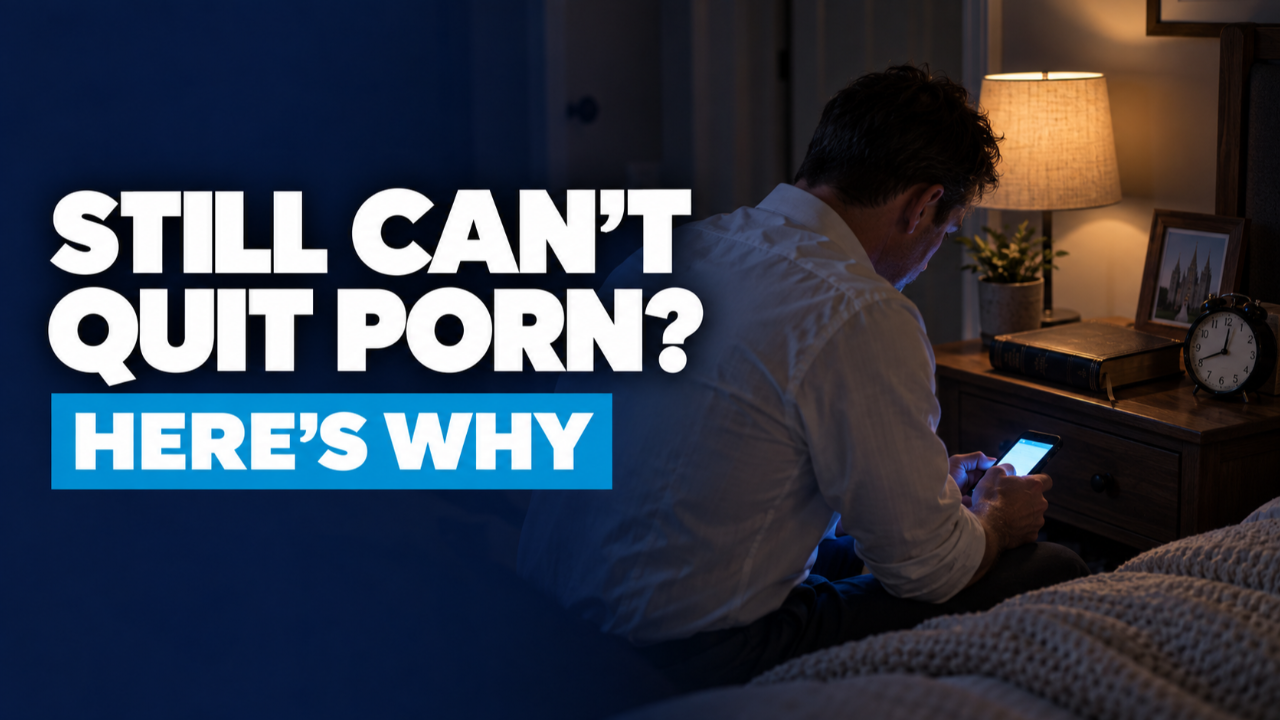
Oct 05, 2026It’s 11:40 on a Tuesday night. The kids have been asleep for hours, your wife turned in early, and you told yourself you’d knock out a few more emails. You know how this goes. You’ve lived it hundreds of times. Tomorrow you’ll make the same promise you made last time: never again.
If you’ve typed “how to stop watching porn” into a search bar more times than you’d like to admit, I want you to hear something first. You are not a bad man trying to be good. You are a good man running an old program.
Most men who find their way to my office have fought this for ten, fifteen, even twenty-five years. They’ve tried filters, accountability partners, books, groups, and months of weekly counseling. They’ve confessed to church leaders more times than they can count and white-knuckled streaks that always ended the same way. Many of them run companies and solve hard problems all day, which makes this one feel even more humiliating.
The Apostle Paul described it perfectly: “For that which I do I allow not: for what I would, that do I not; but what I hate, that do I” (Romans 7:15).
I’ve completed more than 4,000 one-on-one hypnotherapy sessions, hundreds of them with men carrying this exact burden, and I’ve learned that willpower didn’t fail you. You were handed the wrong tool for the right problem. Below, I’ll walk you through what the research says, the cues behind this habit, why the usual advice doesn’t last, and what actually changes the pattern.
Is Porn Addiction Real? What the Research Says
First, know that you’re far from alone. In a 2024 study by Barna Group and Pure Desire Ministries, 75% of Christian men and 40% of Christian women said they view pornography to some extent, and a majority of practicing Christians (54%) reported viewing it. Nearly half of those who view it say no one knows. Feel like the only man in your congregation carrying this? The numbers say otherwise.
The question men ask me most, usually in a near whisper, is “Am I addicted?” Honestly, researchers are still debating what to call it.
The World Health Organization’s diagnostic manual, ICD-11, which took effect in 2022, includes compulsive sexual behavior disorder. Look at where it sits: with impulse control disorders, not addictions. It describes a persistent failure to control intense, repetitive sexual urges, lasting an extended period (for example, six months or more) and causing marked distress or real problems in daily life. It also specifies that distress coming entirely from moral disapproval isn’t enough to meet the definition. The American Psychiatric Association declined to add a hypersexual disorder diagnosis to the DSM-5 in 2013 and again in its 2022 revision.
Men of faith should know about one finding in particular. Research led by Joshua Grubbs, PhD, shows that feeling addicted is strongly linked to moral incongruence: the gap between what you believe and what you actually do. Some take that to mean the answer is to lower your standards. I see it differently. That gap is your conscience telling you the truth about who you want to be, and the pain deserves a real answer.
I rarely use the word addiction with my own clients. In my experience, what feels like slavery is usually a long string of small choices that became automatic, held in place by beliefs about who you are. If you learned your way into a pattern, you can learn your way out. My work is helping men change unwanted habits at the level where habits live.
Why Willpower Keeps Losing: Habits and the Effects of Porn on the Brain
Willpower lives in the conscious mind, the part of you that plans, analyzes, and makes promises. Habits don’t live there.
Habit researcher Wendy Wood found that between a third and half of what we do each day is habitual, repeated in the same setting while our minds are elsewhere. Once a habit forms, it’s triggered by cues in your environment and stops responding to good intentions. In one study, people with a strong movie popcorn habit kept eating stale popcorn they didn’t even like, just because they were sitting in a theater.
Now add what researchers see in the effects of porn on the brain. At the University of Cambridge, Dr. Valerie Voon’s team found that in men with compulsive sexual behavior, explicit cues lit up reward and motivation regions more strongly, and the men reported more “wanting” but no more “liking.” (Voon cautions that this doesn’t prove pornography itself is addictive.) That may be part of why it can feel like chasing something that never satisfies.
Stanford physician Dr. Anna Lembke, author of Dopamine Nation, describes pleasure and pain as a seesaw. In her conversation with Dr. Andrew Huberman, she explains how repeated high-dopamine hits tip the balance toward a deficit state where ordinary life feels flat. That flat, irritable, unmotivated feeling becomes the next cue.
Dr. Joe Dispenza teaches that by our mid-thirties, most of who we are (he estimates about 95 percent) runs on memorized habits, emotional reactions, and beliefs, like a program running in the background. So “try harder” keeps failing. You can’t out-promise a program. You have to change it.
The Three Cues Behind an Unwanted Porn Habit
James wrote that “every man is tempted, when he is drawn away of his own lust, and enticed” (James 1:14). In my office, being drawn away almost always starts with one of three kinds of cues.
1. Emotional cues
The men I work with rarely turn to porn because they’re overflowing with lust. They turn to it because they’re depleted: stress after a brutal day, loneliness in a full house, boredom, feeling unappreciated, an argument with your wife, the heavy mood after a slip. When His disciples couldn’t stay awake in Gethsemane, Jesus told them, “the spirit indeed is willing, but the flesh is weak” (Matthew 26:41). Appetites get loudest when you’re running on empty.
Some emotional cues are decades old. One man traced his pattern to age seven, when he found a picture under the football bleachers and hid it. His adult habit turned out to be less about lust than about secrecy and the fear of being caught.
2. Situational cues
These are about time, place, and state: late nights after everyone’s asleep, the phone on the nightstand, the home office with the door closed, the hotel room at the end of a long trip. Many men describe an eerie autopilot, where the browser is open before they remember deciding anything. As one client put it, “It was just a constant urge in the back of my mind.”
3. The voice that speaks in first person
This is the cue most men never notice: a thought that sounds exactly like your own voice. I hear the same lines in session after session:
- “I deserve it.”
- “I’ve been doing really well. I’ve earned a break.”
- “I’m stressed, and this is the only thing that gives me relief.”
- “Nobody will know.”
- “I’ve already blown it today, so what’s the point?”
Every one of them is in the first person. Whether you see this as an old subconscious program or as what Paul called “the fiery darts of the wicked” (Ephesians 6:16), it feels like your voice, but it isn’t the voice of the man you want to be. Scripture tells us to bring “into captivity every thought to the obedience of Christ” (2 Corinthians 10:5). You can’t take a thought captive until you notice it.
Try this: map your last three episodes
Think back to the last three times it happened and jot down:
- When and where: the time, the room, the device.
- What you felt in the hour before: tired, angry, lonely, bored, unappreciated.
- What the voice said: the exact first-person sentence.
The New Testament word for repentance, metanoia, literally means a change of mind. Mapping your cues is a way of gaining knowledge, and knowledge gives you back your power to choose. You’ll probably notice your pattern looks different from the next man’s, which is why one-size-fits-all advice rarely lasts. Bring your notes if you book a call with us. They often point straight to the root.
Why Shame Makes the Next Slip More Likely
The shame spiral after a slip is one of the strongest cues of all. Guilt drops your mood, a low mood craves relief, and you know where the old program goes looking for it.
I often tell clients to picture a flat tire on the highway. The sensible response is to pull over, put on the spare, and get back on the road. Guilt is getting out and slashing the other three tires. It punishes. It doesn’t solve anything.
Scripture is clear: “There is therefore now no condemnation to them which are in Christ Jesus” (Romans 8:1). His compassions “are new every morning” (Lamentations 3:22-23). Godly sorrow turns you toward the light. Self-condemnation just keeps you circling.
What Actually Changes the Pattern
Most of the advice men get is about managing the behavior. Filters and flip phones limit access. Accountability partners give you someone to report to. Cold showers and push-ups buy a few minutes. Each one asks you to fight the urge, and none of them touches the reason the urge shows up. When willpower runs low, the old program is still running.
Lasting change comes from the other direction: finding the belief that drives the behavior and changing it. That belief is different for every man. For the man from the bleachers, it was the fear of being caught. For another client, it was loneliness that started when he was a boy who wanted more of his mother’s attention, and a tablet became his closest friend. For many, it’s the belief “I am weak,” repeated so often it became an identity. Two men can look at the same screen for completely different reasons, so what worked for the next man may do nothing for you.
In our sessions, you’re guided into a relaxed, focused state where you stay aware and in control. Together we trace the pattern back to where it started, find the belief holding it in place, and replace it with the truth. Two Christian men I worked with, both of whom had struggled since their pre-teen years, said the same words at the end of their first session: “I am free.” Weeks later, both said the urges were gone and it no longer felt like a fight.
If the word hypnosis makes you uneasy, that’s understandable. It’s nothing like a stage show, and you don’t lose control. The American Psychological Association’s Division 30 defines it as a state of focused attention and reduced peripheral awareness, with an enhanced capacity to respond to suggestion. Stanford’s Dr. David Spiegel, a leading hypnosis researcher whose work has deeply shaped mine, puts it plainly: “They think you’re losing control; you’re gaining control.” His team’s brain-imaging research found that during hypnosis, activity drops in a region tied to worry, while connections strengthen between the brain’s control center and the areas that track what’s happening in the body. Dr. Bruce Lipton, author of The Biology of Belief, teaches that the subconscious learns through two main doorways: hypnosis-like states of focus, and repetition. Willpower uses neither.
For men of faith, this work fits naturally with prayer. Deep, unhurried prayer and trance are close cousins. Both quiet the noise of the world so you can receive what’s true. Jesus modeled it, “rising up a great while before day” to pray in “a solitary place” (Mark 1:35). “Be still, and know that I am God” (Psalm 46:10). Christ is always the first and best help. Hypnotherapy can give you back the freedom to choose, so what you pray for can take root. Paul called it being “transformed by the renewing of your mind” (Romans 12:2).
When the pattern keeps coming back no matter what you try on your own, you’re not broken. The root just hasn’t been reached yet, and that’s when it’s time for professional care.
What Freedom Feels Like
Years ago in Brazil, June bugs flew through my open window every night and clung to my skin. At first I battled every one. Within weeks, I barely noticed them land or fly off.
That’s how clients describe life after the pattern shifts. A tempting image may still land now and then, but it’s a June bug, not a dragon. A client who’d carried this for twenty years told me, “I can be at home and feel that I’m actually home, rather than my mind always trying to find something else or distract me.” Another said, “I can literally feel my mind reject it as a trigger.”
Michael Bernard Beckwith often says, “Pain pushes until the vision pulls.” Pain has been pushing you for years. Change sticks when a vision starts to pull. Steven Kotler’s peak performance research describes a motivation stack that starts with curiosity and builds into passion and purpose. Healthy curiosity is a gift. Aim it at what you want most: your marriage, your kids, your work, your walk with God. Peter Crone, known as the Mind Architect, describes his work this way: “I don’t solve problems. I dissolve them.” Managing a habit forever is one thing. Becoming a man it no longer fits is another.
A Private Next Step
If you’ve read this far, you probably recognized yourself here. Maybe in the 11:40 p.m. scene. Maybe in the voice that says, “I deserve it.” Maybe in the fear that you’ll spend another ten years right where you are.
You don’t have to. The pattern isn’t a character flaw. It’s a subconscious identity, and identities can change.
Most men carry this alone. In the Barna study, 84% of people who view porn said no one in their life is helping them avoid it. You don’t have to be one of them.
Your church leader can hear your confession. We help you change. In private, guided hypnotherapy sessions, we help men uncover the root of the pattern and reprogram the beliefs that keep it running, so the behavior no longer fits who they are. Ninety-five percent of clients who follow our program precisely as outlined report lasting change, and the program is backed by a money-back guarantee for those who don’t.
Everything is handled with complete discretion. Confidentiality is the foundation of how we work.
If you’re ready to stop managing this and start living differently, book a free, confidential call with our team. It’s an honest, judgment-free conversation about where you are and whether we’re the right fit.
“Stand fast therefore in the liberty wherewith Christ hath made us free” (Galatians 5:1). Freedom is possible.
About the Author
Nelson Whiting is a National Guild of Hypnotists Certified Instructor, a Certified Clinical Hypnotherapist through the American Council of Hypnotist Examiners and the National Guild of Hypnotists, and the international best-selling author of Your Problem Isn’t Pornography. He has completed more than 4,000 one-on-one sessions. His practice, No Limits Hypnotherapy, is the highest-reviewed and fastest-growing hypnotherapy clinic in Utah, ranked #1 of 98 Utah hypnotherapy clinics by Google reviews.
This article is for educational purposes only and is not medical or mental health advice. Nelson Whiting is a certified hypnotherapist, not a licensed physician or mental health professional, and No Limits Hypnotherapy does not diagnose or treat any medical or mental health condition. For ongoing low mood, anxious feelings, or other health concerns, please see a licensed professional. If you are in crisis, call or text 988, or call 911 in an emergency. Client details are withheld for privacy. Scripture quotations are from the King James Version.