
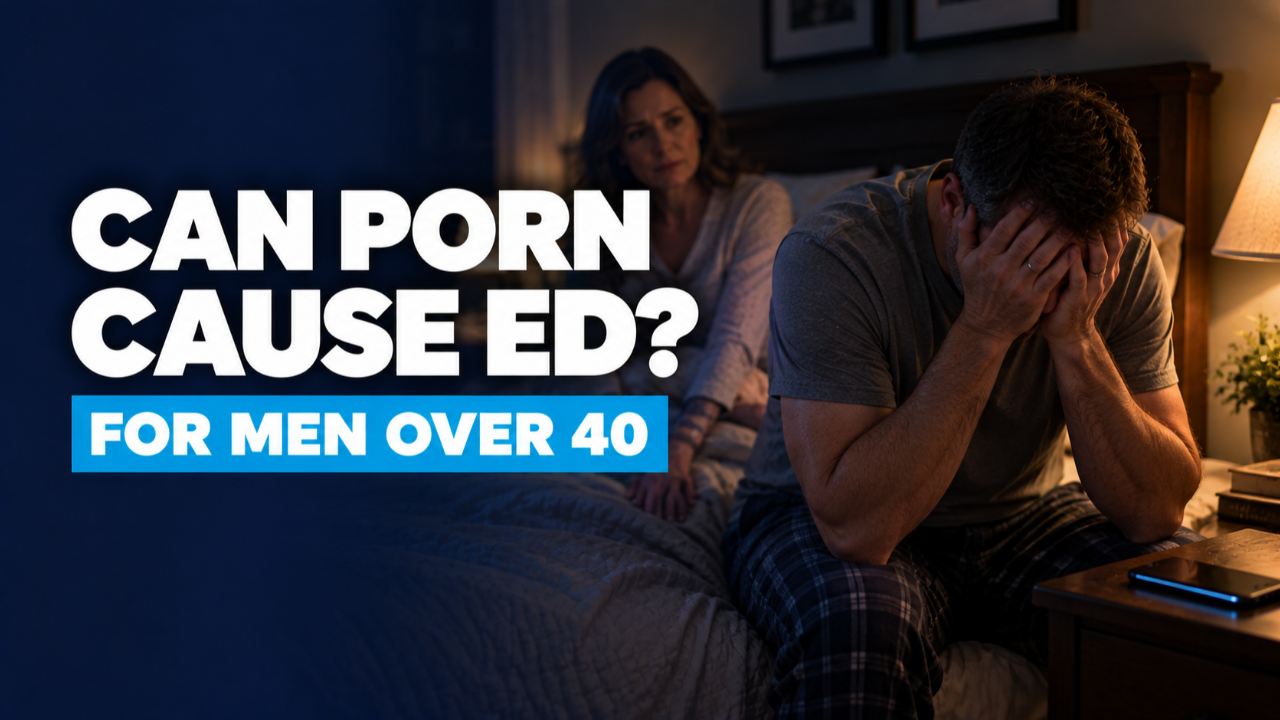
Can Porn Cause ED? What Men Over 40 Should Know
Oct 14, 2026Some questions a man types into his phone but never says out loud. This is one of them, searched from a parked car and cleared from history right after: can porn cause ED?
Maybe you noticed a change months ago and blamed stress or age. Maybe your wife has started to wonder whether it’s her. Under all of it may sit a fear you haven’t told anyone: that a habit you’ve hidden for twenty years has followed you into your marriage.
Here is the short answer. Yes, pornography can play a real part in erection problems, and the reason often has more to do with the mind than most men are told. Some erectile problems may have physical roots too. But a body problem and a mind problem are rarely separate things.
You are also far from alone. In a 2021 national survey of couples by Brigham Young University’s Wheatley Institute, roughly three in four married men reported at least some current pornography use. Many of the men sitting near you on Sunday are carrying the same thing.
I’m not a physician, and I won’t tell you what’s happening in your body. I’m a certified clinical hypnotherapist who has completed more than 4,000 one-on-one sessions, many of them with men breaking free from a pornography habit. What I can offer is a plain reading of the research and a clear view of the habit itself.
Can Porn Cause ED? What the Research Shows
Researchers have been watching the numbers change for twenty years, and the change is hard to ignore.
Erection problems are showing up in younger men
In 2016, a team that included U.S. Navy physicians published a review in Behavioral Sciences. Here is what they found when they lined up older and newer studies. Around 2002, only about 2 out of every 100 men under 40 had erection problems. By 2011, a survey of young men in three European countries found 14 to 28 out of every 100. A 2012 Swiss study of men ages 18 to 24 found 30 out of 100.
The doctors asked a simple question: what changed? Their answer was internet pornography, with its endless supply of new images. They believed it could train a man’s arousal to respond to a screen instead of to his wife. They also described real patients. Two servicemen saw their problems ease after they cut back sharply on pornography or stopped. A third, a 40-year-old husband, tried hard for three months to cut back and found he couldn’t.
A 2019 study published in Military Medicine asked men ages 20 to 40 at a urology clinic two questions: did they have erection problems, and did they prefer pornography or a real partner? Among men who preferred a partner, about 22 out of 100 had problems. Among men who preferred pornography, it was 78 out of 100. That is more than three times as many.
How a man feels about the habit counts too
A 2021 online survey of 942 men ages 18 to 44 looked at whether men felt hooked on pornography. The men who said they felt addicted were the ones more likely to report erection problems. In other words, the struggle itself, the feeling of being stuck and out of control, seems to follow a man into the bedroom.
Keep one thing in mind with surveys like these. They only measure what a man notices and is willing to write down on a quick form. In my office, when men slow down and look closely, almost every one of them finds the habit has cost him more than he first admitted. Whether a man calls his use frequent or a problem, both do damage.
In my book, Your Problem Isn’t Pornography, I put it this way:
“That’s going to sap your energy, waste a lot of your brain space and time, and make you even more depressed and anxious, besides ruining your relationships because you’ve lost confidence, and often leads (for men) to problems like erectile dysfunction.”
ED After 40: Body and Mind Together
Erectile problems become more common with age. According to the National Institute of Diabetes and Digestive and Kidney Diseases (NIDDK), 30 million to 50 million American men have ED. About 4 in 10 men are affected at age 40, and 7 in 10 by age 70.
Some erectile problems may have physical roots. The Mayo Clinic lists heart disease, clogged blood vessels, high blood pressure, high cholesterol, diabetes, obesity, certain medicines, tobacco, heavy drinking, and poor sleep. The same list includes stress, anxiety, low mood, and problems with a partner.
Blood flow is not the root
Many men leave a doctor’s office hearing that erection problems are “a blood flow issue.” That describes what is happening. It doesn’t explain why. Something has to tell those small arteries to tighten, and the mind is very good at doing exactly that.
Here is how it works in plain words. Your body has a stress system, often called fight-or-flight. When it switches on, its nerves release a chemical called noradrenaline. A 2008 review in the International Journal of Impotence Research explains that these stress nerves keep the penis soft by squeezing its arteries and veins tight. For an erection to happen, those arteries have to relax and open.
So think about what a man brings into the bedroom after years of a hidden habit: fear of failing, guilt, comparison, a secret he is guarding. Each one can flip that stress switch on. When the switch is on, the arteries stay tight, no matter how much he loves his wife. Fix the fear and the beliefs underneath it, and the body often follows.
Porn-Induced Erectile Dysfunction: How the Habit Affects Intimacy
Porn-induced erectile dysfunction, often shortened to PIED, means erection problems with a partner that are tied to pornography use. Here are the main ways the habit gets into a marriage.
Conditioning and novelty
The brain gets good at whatever it practices. Park and his colleagues explained that endless variety and escalation can train arousal toward a screen. Real intimacy is personal and familiar, and a brain trained on constant novelty may not respond to it the same way. The International Society for Sexual Medicine (ISSM) describes the same idea: too much viewing can dull a man’s response to real-life intimacy.
Performance pressure
Worry is hard on arousal. In a 2011 study of adults in long-term relationships, researchers Andrea Nelson and Christine Purdon asked people what went through their minds during intimacy. The people who were busy watching and judging themselves, instead of enjoying the moment, reported more sexual problems.
This kind of worry is common. A 2020 review in Sexual Medicine Reviews estimated that performance anxiety affects 9 to 25 out of every 100 men. The ISSM describes the cycle simply: a man fears failing, has trouble, then worries even more about the next time. Comparing himself with men on a screen only adds to the pressure.
Secrecy and shame
A man who has kept a secret for decades doesn’t leave it at the bedroom door. The ISSM lists guilt about one’s own sexual behavior among the things that can contribute to erection problems.
For men of faith, that inner conflict is loud. You love God and you love your wife, and for years part of your life has pulled against both. The weight a man carries about the habit often does as much harm as the habit itself.
A divided mind
Intimacy asks for presence. The same 2011 study found that people who had more distracting thoughts during intimacy, and a harder time bringing their attention back, reported more sexual problems.
When a man is checking on himself or guarding a secret, part of him is somewhere else. His wife can feel it, even if she can’t name it.
What Intimacy Was Meant to Be
Over time, many men start to treat intimacy like a test they might fail. That is a heavy thing to carry into the part of marriage that was meant for joy.
“Live joyfully with the wife whom thou lovest all the days of the life of thy vanity, which he hath given thee under the sun, all the days of thy vanity: for that is thy portion in this life, and in thy labour which thou takest under the sun” (Ecclesiastes 9:9).
The writer of Ecclesiastes tried nearly every pleasure the world could offer. When he named a man’s portion in this life, he pointed to joy with the wife he loves. Not performance, and not proving anything. Joy.
God’s design for that joy was clear from the beginning: “Therefore shall a man leave his father and his mother, and shall cleave unto his wife: and they shall be one flesh” (Genesis 2:24). Cleaving to your wife leaves no room for anyone else, including the people on a screen. That is why pornography damages every marriage it touches.
Fear works against that joy. John wrote, “There is no fear in love; but perfect love casteth out fear: because fear hath torment. He that feareth is not made perfect in love” (1 John 4:18). Performance pressure is a kind of torment, and so is shame. Neither one belongs between you and your wife.
Christ is always the first and best help, and He often works through a good marriage and good people around you. Hypnotherapy is a focus tool that works alongside prayer, never a replacement for faith.
Is It Too Late to Change After 40?
Many men reading this have carried the habit since their teens. Under the question about ED sits another one: if this has been running since I was young, can I really change now?
You can, and age doesn’t slow it down. In my book, I wrote about exactly this:
“And it doesn’t matter if you’re old or young in this process of attempting change. You can, indeed, teach an old dog new tricks. I’ve had plenty of men in their 50+ age come in and fix the problem just as fast as young men. One of them had been to 11 years of therapy for pornography habits, but when he came in to see me, we got it fixed in 1 session.”
Eleven years, then one session. That isn’t luck. The subconscious mind doesn’t deal in time or size. It doesn’t care how big the problem is or how long it has been there. It can change at the speed of thought.
Decades of struggle are not necessarily a sign of a flawed character. The pattern is an identity your subconscious mind learned, and what was learned can change at 45 or at 60.
My work isn’t medical, and I don’t prescribe anything. What we help men change is the habit itself: the pull toward the screen, and the beliefs about themselves that keep it running. Often, once those beliefs change, the fear and pressure that followed them into the bedroom lose their grip too.
Every man’s root is different. For some men, the habit is a way to come down after relentless pressure at work. Others are soothing a loneliness they have never named. Our guide to the cues behind an unwanted porn habit explains what sets off an episode in the moment. Our clinical sessions go beneath those cues to the belief holding the pattern in place.
One client described his freedom this way in a Google review:
“I’m so excited that I feel totally free of this and stronger than I ever have before!” (Cameron R., Google review)
Frequently Asked Questions
Can porn cause ED in men over 40?
It can. Pornography can train arousal toward a screen, and the fear, guilt, and secrecy around a long habit can switch on the body’s stress system, which tightens the very arteries an erection depends on. Some erectile problems may have physical roots as well, such as high blood pressure, diabetes, or a medication’s side effects. For many men, the full picture is a mix of mind and body, and the mind is often where the change begins.
Is ED a normal part of getting older?
It becomes more common with age, but the NIDDK says plainly that ED is “not a routine part of aging.” That is good news. It means there is a reason worth finding.
Is PIED recovery possible?
Yes. The 2016 clinical reports describe men whose erection problems improved after they stopped or sharply cut back on pornography. The hard part for most men is stopping at all. If you can’t step away from pornography even when you sincerely want to, the habit lives deeper than willpower, and that is exactly where our work happens. For most of our clients, one session is enough to end the habit.
When You’re Ready to Talk
Pornography may have been part of your life for longer than you ever intended. You don’t have to keep fighting it alone and in secret.
Most of the men I work with have already tried filters, accountability partners, and sincere promises. They aren’t weak or unwilling. Willpower just isn’t the right tool to fix a habit. The pattern lives deeper than behavior, in beliefs about who they are, and when the work reaches that level, the behavior stops fitting the man.
Our program is built to help men break free from unwanted pornography use, with a 95% recovery rate in as little as 1-3 sessions, guaranteed. For many men it takes just one session, and the program is backed by a money-back guarantee.
Sessions are private and one-on-one, in person in Utah or by video anywhere. Your privacy is protected from the first conversation to the last.
The first step is a small one. Schedule your free, confidential call and bring every question you’ve been carrying, including the ones you’ve never asked anyone. Nobody will pressure you to decide anything on the call.
You’ve carried this privately for years. You don’t have to carry it into the next decade.
About the Author
Nelson Whiting is a National Guild of Hypnotists Certified Instructor, a Certified Clinical Hypnotherapist through the American Council of Hypnotist Examiners and the National Guild of Hypnotists, and the international best-selling author of Your Problem Isn’t Pornography. He has completed more than 4,000 one-on-one sessions. His practice, No Limits Hypnotherapy, is the highest-reviewed and fastest-growing hypnotherapy clinic in Utah, ranked #1 of 98 Utah hypnotherapy clinics by Google reviews.
If you are having thoughts of suicide, call or text 988, or call 911 in an emergency. Client details are withheld for privacy. Scripture quotations are from the King James Version.
Sources
- Wheatley Institute, Brigham Young University, National Couples and Pornography Survey 2021, 2021
- Park, B. Y., Wilson, G., Berger, J., et al., Is Internet Pornography Causing Sexual Dysfunctions? A Review with Clinical Reports, 2016
- Berger, J. H., Kehoe, J. E., Doan, A. P., et al., Survey of Sexual Function and Pornography, 2019
- Whelan, G., and Brown, J., Pornography Addiction: An Exploration of the Association Between Use, Perceived Addiction, Erectile Dysfunction, Premature (Early) Ejaculation, and Sexual Satisfaction in Males Aged 18 to 44 Years, 2021
- National Institute of Diabetes and Digestive and Kidney Diseases, Definition & Facts for Erectile Dysfunction, 2024
- Mayo Clinic, Erectile Dysfunction: Symptoms and Causes, 2025
- Prieto, D., Physiological Regulation of Penile Arteries and Veins, 2008
- International Society for Sexual Medicine, Can Problematic Pornography Use Contribute to Sexual Dysfunction?, 2022
- Nelson, A. L., and Purdon, C., Non-Erotic Thoughts, Attentional Focus, and Sexual Problems in a Community Sample, 2011
- Pyke, R. E., Sexual Performance Anxiety, 2020
- International Society for Sexual Medicine, What Is Sexual Performance Anxiety and How Can One Manage It?, 2021
- Bible Gateway, Ecclesiastes 9:9 (KJV), accessed 2026
- Bible Gateway, Genesis 2:24 (KJV), accessed 2026
- Bible Gateway, 1 John 4:18 (KJV), accessed 2026
- Whiting, N., Your Problem Isn’t Pornography, 2025