
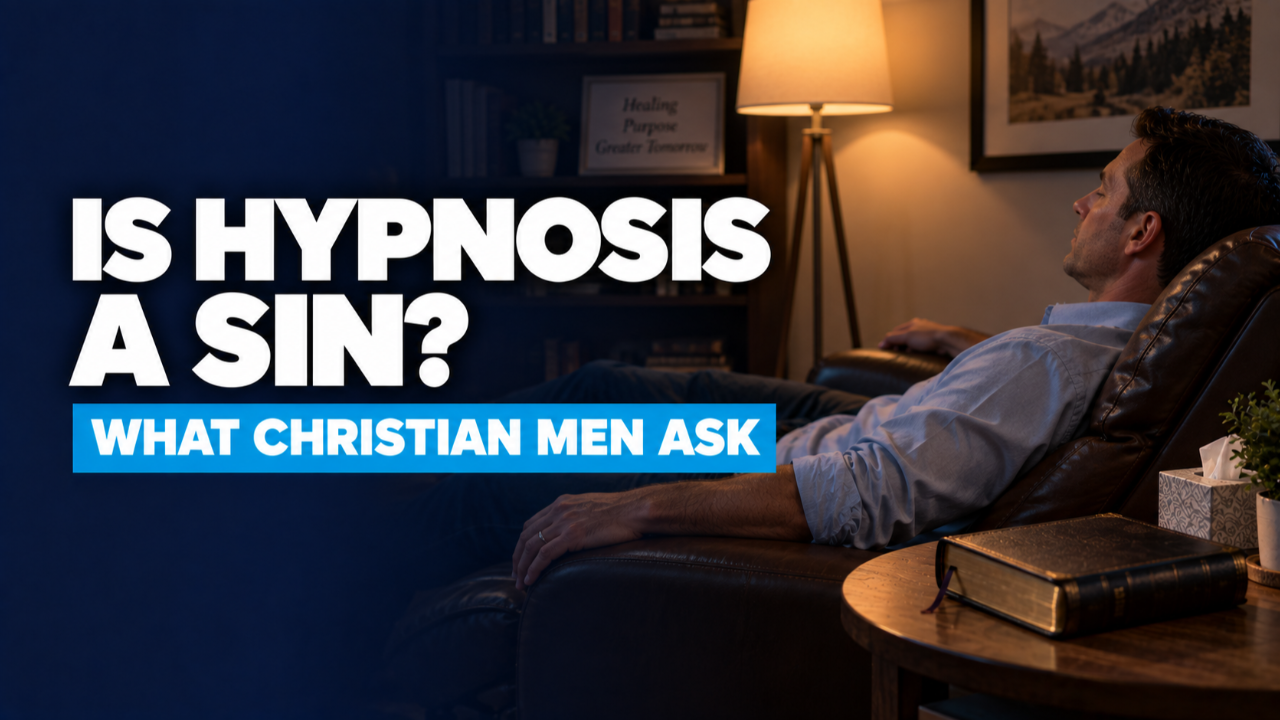
Is Hypnosis a Sin? What Christian Men Ask Before Getting Help
Oct 16, 2026Not one person who has called me has asked whether hypnosis is a sin. What they ask is what hypnosis actually is, usually because a church leader once told them it was a sin. Most of them are open and willing to investigate, and that’s exactly what this article is for.
If you’ve fought a pornography habit for years and heard that hypnosis might help, you may be carrying that same question. So let’s answer it plainly: is hypnosis a sin?
My short answer is no, not as it’s used in a clinical setting. Hypnosis is a natural state of focused attention, the kind of focus you feel when a good book holds you for an afternoon or when you lose track of time in prayer.
Scripture never condemns focused attention. In fact, Scripture shows trance as a prime state for receiving revelation. Peter and Paul both fell into a trance and received from the Lord what didn’t come to them in a normal waking state. What Scripture condemns is occult practice: divination, spells, consulting the dead, and surrendering your will to darkness. Clinical hypnotherapy involves none of those, and you stay in control the whole time.
A man whose faith runs deep shouldn’t hand his mind to anything he hasn’t tested. So let’s test it, starting with the verses men worry about.
Is Hypnosis a Sin? What Scripture Actually Forbids
Many men who wrestle with this have one passage in mind.
“There shall not be found among you any one that maketh his son or his daughter to pass through the fire, or that useth divination, or an observer of times, or an enchanter, or a witch. Or a charmer, or a consulter with familiar spirits, or a wizard, or a necromancer” (Deuteronomy 18:10-11).
Notice the company the word “charmer” keeps. In Hebrew it describes someone who casts spells, and the list around it runs from child sacrifice to fortune-telling, sorcery, and calling up the dead. The verse just before it says, “When thou art come into the land which the LORD thy God giveth thee, thou shalt not learn to do after the abominations of those nations” (Deuteronomy 18:9). Each one looks to spirits or false gods for hidden power instead of to the Lord.
Nothing in a clinical session resembles that list. No spirits are consulted and no spells are cast. A trained hypnotherapist helps you narrow your attention so you can see clearly the beliefs behind a habit you want gone, and then choose what’s true.
Scripture asks you to test things like this rather than accept or reject them blindly: “Prove all things; hold fast that which is good” (1 Thessalonians 5:21). A fair test looks at what a practice draws on and what it produces.
Focused attention, on its own, is something the Bible commends. Of the blessed man, the first psalm says, “But his delight is in the law of the LORD; and in his law doth he meditate day and night” (Psalm 1:2). The question was never whether your mind is focused. It’s what your mind is fixed on, and whom you trust.
Is Hypnosis Demonic? What Happens in a Real Session
Is hypnosis demonic? Clinical hypnosis doesn’t call on any spirit. It works with your own focused attention.
Most of the fear comes from the stage. My own first experience with hypnosis was a stage show at my high school’s 2005 senior graduation party. Here is how I described it in my book, Your Problem Isn’t Pornography:
“There I was lying in a pile on the floor on stage in front of 500 people, in a hypnotic coma. I had just slumped out of my chair and slammed my head so loudly on the hard-wood floor I could hear the audible collective ‘gasp’ from the audience. … They laughed, they were entertained, but I walked away feeling that my life had just changed forever, and it wasn’t because I was embarrassed about anything.”
It took years, and certification in clinical hypnotherapy, before I found the other side of hypnosis: a private office, a goal the client chose, and nobody clucking like a chicken. As I wrote in the book, “For me, hypnosis was never weird, scary, or brainwashing. For me it was a power of the mind that demanded careful exploration. Hypnosis, like prayer, causes miraculous change very consistently.”
Behind much of the hesitation is a fear of being vulnerable while your guard is down. Medical sources are clear on the basics:
- You stay in control. Whatever you’ve seen on stage, Mayo Clinic notes that “people don’t lose control over their behavior during hypnosis” (Mayo Clinic). You can speak up or stop at any point.
- You stay aware. Most people remain aware during a session and remember it afterward, according to both Mayo Clinic and Cleveland Clinic. Some people don’t remember it all because they fall asleep.
- The choice stays yours. Cleveland Clinic explains that hypnosis isn’t mind control, and that any change in your habits comes from your own decision to make it (Cleveland Clinic).
- It’s a state of focus. Stanford psychiatrist Dr. David Spiegel describes hypnosis as highly focused attention, much like being so absorbed in a film that you forget you’re watching one (Stanford Medicine).
In a 2024 interview he put it simply: “It’s an opportunity for change, it’s not turning yourself over to somebody else’s control.”
In my office, clients don’t do anything in hypnosis they don’t want to do. All hypnosis is, in a real sense, self-hypnosis, because nothing happens unless you allow it.
I can’t make you relax, and I can’t make you feel anything. Even so, everyone can be hypnotized, and I’ve never had a paying client who couldn’t go into hypnosis.
For some Christian men, the worry is that by lowering their guard they’re letting darkness take control of them. In fact, hypnosis increases your ability to align with what you believe. It doesn’t decrease it.
The work never asks you to empty your mind or surrender your will. It asks you to focus, while you stay aware and free to say no. What fills that focus is the truth you already believe about God and about yourself, set in place of the old lies.
Our article on the cues behind an unwanted habit describes what a session with us is like. If you’d like to experience a light trance privately first, our free clinical audio for releasing guilt includes a short induction.
Trance, Prayer, and the Zone: Is Hypnosis Biblical?
Hypnosis never appears in the Bible, but trance does. The King James New Testament uses the word three times, and each time an apostle is praying.
“Peter went up upon the housetop to pray about the sixth hour: And he became very hungry, and would have eaten: but while they made ready, he fell into a trance” (Acts 10:9-10).
In that trance, Peter “saw heaven opened” (Acts 10:11) and received a revelation that changed the early church. Later he told the other apostles, “I was in the city of Joppa praying: and in a trance I saw a vision, A certain vessel descend, as it had been a great sheet, let down from heaven by four corners; and it came even to me” (Acts 11:5).
Paul describes his own: “And it came to pass, that, when I was come again to Jerusalem, even while I prayed in the temple, I was in a trance” (Acts 22:17). In that state, the Lord spoke to him and gave him direction. Vine’s Expository Dictionary describes the biblical trance as a condition in which “the soul was susceptible only to the vision imparted by God” (Blue Letter Bible).
So Scripture doesn’t treat a deeply focused, inward state as evil. It shows it as a prime state for receiving from the Lord what didn’t come in a normal waking state, in the middle of prayer.
Steven Kotler, whose work has shaped my thinking, calls this state flow, an “optimal state of consciousness where we feel our best and perform our best” (Psychology Today). In flow, he explains, the part of the brain that handles self-monitoring switches off, taking the inner critic with it.
In a 2018 study, college students who got “in the zone” more often also responded to hypnosis more strongly, and the researchers suggested hypnosis may help people reach that state more often (Bowers, Na and Elkins).
Nobody thinks a quarterback in the zone is dabbling in the occult. He’s focused. So is a man in a session, and so is a man deep in prayer.
Does Hypnosis Work? What Medicine and Research Say
Your worry is as old as the word hypnotism itself. In April 1842, a Liverpool clergyman told his congregation that mesmerism, the forerunner of hypnosis, was the work of Satan. James Braid, the Manchester surgeon who gave hypnotism its name, answered him in a published letter (Wichita State University Libraries). His experiments had convinced him the effects came from the subject’s own concentrated attention.
A century later, mainstream medicine weighed in. In 1955, the British Medical Association approved a report that called the hypnotic state “a temporary condition of altered attention” and found real medical uses for it, including pain relief in surgery and childbirth (quoted in Donald Robertson’s review). In 1958, the American Medical Association adopted a report on the medical use of hypnosis that recognized its place in medicine and condemned hypnosis as entertainment. Those reports are history, not a seal of approval on anyone practicing today, including me, but they show what doctors found when they looked closely.
As for whether it works, a 2024 review pulled together 49 big summaries of research, covering 261 studies. In plain terms, researchers checked whether people who got hypnosis did better than people who didn’t. Nearly every result they counted (99.2%) favored hypnosis, with the strongest evidence for pain and medical procedures. Most of those summaries compared hypnosis against a fake treatment, to make sure the change wasn’t just people expecting to feel better. The review also cites a 2018 analysis that found no serious harmful events caused by hypnosis.
In my office, that same focused state is what lets a man change a pornography habit fast. As I wrote in my book:
“And when it comes to porn problems, they can be fixed extremely quickly in a clinical hypnotherapy setting. In fact, of the 3,000 one-on-one sessions I’ve personally completed with clients, about 300 of which have been specific to pornography-habituated clients and the success rates are the same whether it’s for porn or some other so-called ‘untreatable’ issue. No matter the issue, across the board my clients (and the clients of hypnotherapists that work for me) have experienced a 95%+ success rate in 1-3 hypnosis sessions or less.”
I’ve now completed more than 4,000 sessions, and one-session results are typical. The neuroscience points the same way: the subconscious doesn’t deal in time or size. It doesn’t care how big the problem is or how long it has been there. It can change at the speed of thought.
Hypnosis and Christianity: Christ First, Always
Where do I stand? Christ is the first and best help, always. Hypnotherapy is no substitute for prayer, scripture, repentance, or your walk with God. It’s a focus tool, exactly like prayer and meditation, and it works alongside them. In my book I put it this way: “Hypnotherapy is a focus tool that helps you regain freedom to choose in order to reach the kingdom of God within you and pull the insight or truth out that is needed to immediately and permanently overcome this weakness of yours.”
Some men ask whether this is a spiritual battle or a problem in the mind. It’s usually both. Many of the men I work with have prayed sincerely for years and still feel something old pulling against every prayer. If that’s you, you’re far from alone. In a 2021 national survey of couples by Brigham Young University’s Wheatley Institute, roughly three in four married men reported at least some current pornography use.
God didn’t fail these men. Usually a belief formed long ago is still overriding what they choose today, without their noticing it. A session can break its grip and give a man back his freedom to choose, so the change he’s been asking God for has room to grow.
Sometimes a session goes somewhere neither of us planned. From my book:
“I had a client come in and he had a wonderful hypnotherapy session where he veered off from where I thought the session was going to go. He ended up connected with Christ, solved his pornography problem (which actually didn’t originate at all from something sexual). When he came out he said that was the first time he’d experienced the atonement, or God’s grace. It’s been months and he hasn’t had the slightest urge for porn since.”
That was one session. I didn’t steer him there. That was between him and God.
Another past client wrote this about his sessions, in a testimonial printed in the book:
“The experience I had was so personal and so real. Nelson helped me to dig deeper into parts of my mind where I would usually give up. … All I know is from my sessions with Nelson, my love for a Savior who truly atoned for our sins is real. That forgiveness is real.” (a past client)
Not every Christian sees hypnosis the way I do, and I respect that. Some Christian writers urge believers to avoid it, warning that setting aside critical thinking could expose the mind to harmful, even demonic, influence. The irony is that your faulty critical thinking is what has gotten you stuck in your problem.
One Christian site says, “We should not give over control of our minds to others” (Compelling Truth), and a Christianity.com article agrees. So do I, which is exactly why our work never asks you to.
Dr. Andrew Fergusson, writing for the Christian Medical Fellowship, took a careful middle road. He accepted a limited place for hypnosis in medicine, called its use as entertainment an abuse, and proposed three tests: what the practitioner intends, what methods he uses, and whether the client consents with full understanding and a clear conscience. His bottom line: “If in doubt, leave it out” (Christian Medical Fellowship).
But I say, when in doubt, try it out and prove its worth, especially when over 1,000 other faithful, devoted Christians report success with it. That is what Paul asked of us when he wrote “Prove all things.” Hold us to every one of Dr. Fergusson’s tests. On questions where sincere believers differ, Paul’s counsel still holds: “One man esteemeth one day above another: another esteemeth every day alike. Let every man be fully persuaded in his own mind” (Romans 14:5).
Questions Men Ask Before Their First Session
Is hypnosis against Christianity?
The Bible never mentions hypnosis by name. What Scripture clearly forbids is occult practice, from fortune-telling to consulting the dead. Clinical hypnosis is focused attention, aimed at goals you choose, with your full awareness. Scripture even shows Peter and Paul receiving revelation in a trance while they prayed. Weigh it against God’s word and your own conscience, and look at the fruit it bears.
Is there such a thing as Christian hypnosis?
Hypnosis itself is neither Christian nor anti-Christian, any more than concentration is. What makes the work fit your faith is everything around it: a practitioner whose character you trust, methods that never manipulate, and your full, informed consent. In our sessions, your faith is welcome in the room, and nothing we do asks you to set it aside.
What will my wife or church leader think?
They may share your questions, and that’s healthy, so feel free to talk it over with them first and bring their concerns to a call. We work with wives and betrayed spouses often, too. We don’t speak for any church and never claim a church’s approval; what we offer is complete confidentiality and straight answers. Your church leader can hear your confession. We help you change.
What if it works for other men but not for me?
After years of disappointment, that fear makes sense. But everyone can be hypnotized, and anyone who has this problem and meets our criteria for success can make rapid and permanent change. Every man’s root is different, so sessions are built around your history and the beliefs behind your pattern. If you’re still weighing your options, our guide on where to actually start lays them out. Bring that fear to the call, and we’ll talk it through.
Talk It Through Before You Decide
You deserve freedom that doesn’t cost you your conscience. We want that for you, too.
What you’ve been fighting is a subconscious identity, written years ago, and what was written can be rewritten. In private, one-on-one clinical hypnotherapy sessions, in person in Utah or by video anywhere, we help men find the belief at the root of the pattern and replace it with what’s true. You stay in control the entire time, and everything you share stays confidential.
Our clients see a 95% recovery rate in as little as 1-3 sessions, guaranteed. If you follow the program as outlined and don’t see results, you get your money back. Many men need only one session.
You don’t have to settle every question today. Start with a conversation: schedule your free, confidential call and ask anything, including every faith question you still have. There’s no pressure. If you’re reading this for your husband, you’re welcome to pass it along or bring your own questions to us.
“For God hath not given us the spirit of fear; but of power, and of love, and of a sound mind” (2 Timothy 1:7).
About the Author
Nelson Whiting is a National Guild of Hypnotists Certified Instructor, a Certified Clinical Hypnotherapist through the American Council of Hypnotist Examiners and the National Guild of Hypnotists, and the international best-selling author of Your Problem Isn’t Pornography. He has completed more than 4,000 one-on-one sessions. His practice, No Limits Hypnotherapy, is the highest-reviewed and fastest-growing hypnotherapy clinic in Utah, ranked #1 of 98 Utah hypnotherapy clinics by Google reviews.
If you are having thoughts of suicide, call or text 988, or call 911 in an emergency. Client details are withheld for privacy. Scripture quotations are from the King James Version.
Sources
- Mayo Clinic Staff, Hypnosis, 2026
- Cleveland Clinic, Hypnosis: What It Is, How It Works, Benefits & Risks, 2025
- Nina Bai, Stanford Medicine, How hypnosis can alter the brain’s perception of pain, 2023
- Simon Hill, The Proof Podcast, The benefits of hypnosis: David Spiegel, MD, 2024
- Steven Kotler, Psychology Today, Flow States and Creativity, 2014
- Juliette Bowers, Hyeji Na, and Gary Elkins, International Journal of Clinical and Experimental Hypnosis, Flow and Hypnotizability in a College Student Population, 2018
- James Braid, Wichita State University Libraries (Tinterow Collection), Satanic Agency and Mesmerism Reviewed, 1842
- Council on Mental Health, Journal of the American Medical Association, Medical Use of Hypnosis, 1958
- Donald Robertson, The Hypnotherapy Journal, The Medical & Scientific Approval of Hypnotherapy, 2006
- Jenny Rosendahl, Cameron T. Alldredge, and Antonia Haddenhorst, Frontiers in Psychology, Meta-analytic evidence on the efficacy of hypnosis for mental and somatic health issues: a 20-year perspective, 2024
- Wheatley Institute, Brigham Young University, National Couples and Pornography Survey 2021, 2021
- E. Vine, Blue Letter Bible, Vine’s Expository Dictionary of New Testament Words: Trance, 1940
- Andrew Fergusson, Christian Medical Fellowship (Nucleus), Hypnosis, 1996
- Compelling Truth, Should a Christian be involved with hypnosis?, accessed 2026
- Vivian Bricker, Christianity.com, What Does the Bible Say about Hypnosis?, 2023
- Nelson Whiting, Your Problem Isn’t Pornography, 2025