
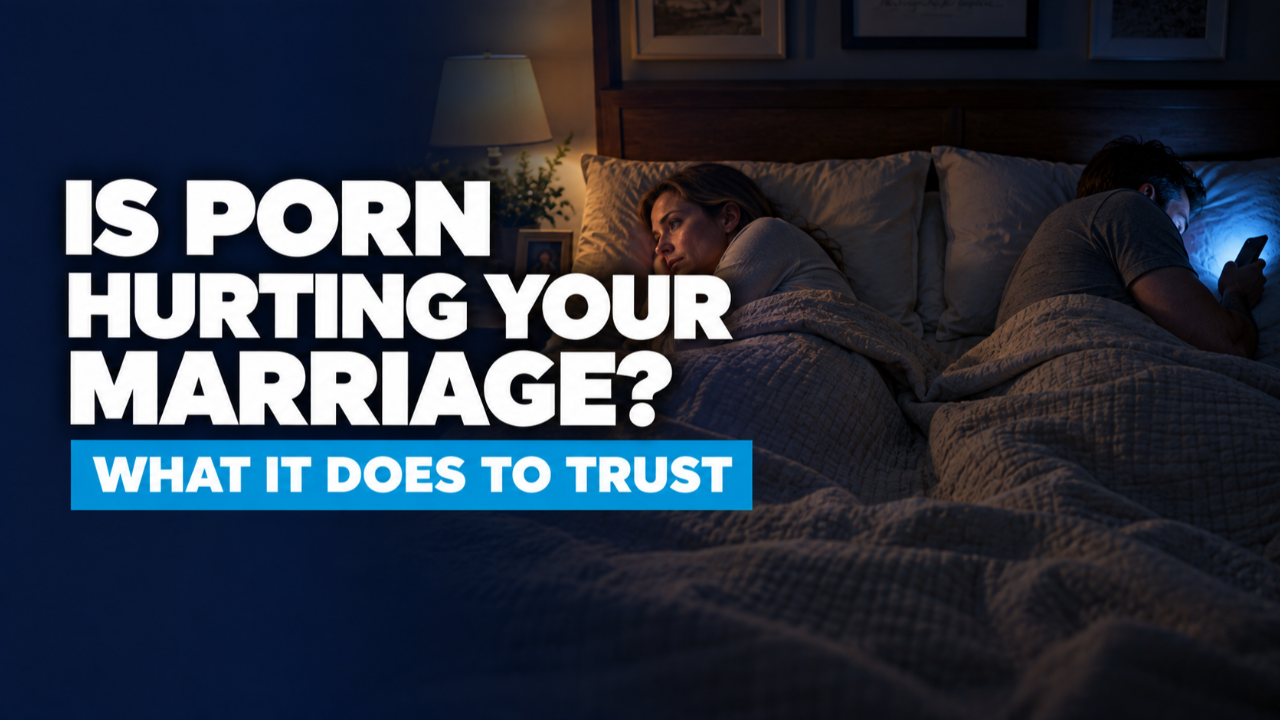
Porn in Marriage: What It Really Does to Trust and Intimacy
Oct 09, 2026You can hold your wife’s hand through an entire church service and still feel the distance. She’s right beside you, and she has no idea there’s a room in your life she has never been allowed into.
Or maybe she found her way in. Maybe she picked up the wrong device, and now there’s a silence at the dinner table you’ve never heard before.
Either way, you’ve probably asked yourself a question you would never say out loud: is watching porn in a relationship bad, even if it stays private?
Yes. It damages every marriage it touches. You are also far from alone in asking. Roughly three in four married men report at least some current pornography use, and in more than 4,000 one-on-one sessions I’ve met many of them. They love their wives. Many of them carried this pattern long before their wedding day.
None of that excuses the habit, and none of it makes you hopeless. The pattern is not necessarily a character flaw. Most often it’s a subconscious identity, formed years ago, and identities can change. When a husband changes at that level, trust finally has something solid to rebuild on.
Is Watching Porn in a Relationship Bad? What the Research Shows
Start with how common this is. In 2021, Brigham Young University’s Wheatley Institute asked couples across the country about pornography in their national survey of couples. Roughly three in four married men said they had at least some current pornography use. One in four men said they hide their viewing from their partner, and one in five couples said they fight about it.
So you are normal in one sense. But common doesn’t mean harmless. To see what it costs, look at what happens to couples over time.
Sociologists Samuel Perry and Cyrus Schleifer followed married Americans through a national survey taken every few years from 2006 to 2014. People who started watching pornography between one survey and the next were about twice as likely to be divorced by the next one. The American Sociological Association put it in simple numbers: the chance of divorce went from about 6 in 100 to 11 in 100. For people who had called their marriage “very happy” at the start, it went from 3 in 100 to 12 in 100.
In a second study, Perry looked at married people in 2006 and again in 2012. Those who watched pornography more often in 2006 said their marriages were worse in 2012, even when he compared couples whose marriages had started out equally strong. The drop showed up for husbands.
Economists Kirk Doran and Joseph Price looked at answers from about 20,000 adults who had been married. Those who had watched an X-rated film in the past year had more divorce, more affairs, and less happiness in their marriages.
Scripture explains why every marriage pays a price. From the very beginning, a husband was told where his heart belongs.
“Therefore shall a man leave his father and his mother, and shall cleave unto his wife: and they shall be one flesh” (Genesis 2:24).
To cleave means to hold fast to one woman and none else. Pornography sends a husband’s desire somewhere else, so it pulls against that bond in every marriage, whether or not anyone finds out.
Even when a marriage survives, staying married and staying close are two different things. I meet many faithful husbands whose marriages look fine from the outside and feel lonely on the inside.
What Your Wife May Be Feeling
When a wife finds out about her husband’s pornography use, the hurt usually runs deeper than either of them expects, and it reaches far past what was on the screen.
Researchers Raymond Bergner and Ana Bridges read 100 personal letters written by women whose partners watched a lot of pornography. Many of the women described finding out as a shock that felt like trauma. They wrote about what it meant for the relationship, for their own worth and attractiveness, and for who their husband really was.
Each of those cuts deep. Finding out often feels like betrayal, even when there was never an affair, and a wife may start comparing herself to images no real woman could match.
She may have felt lonely in the marriage long before she knew the reason. Hardest for a husband to hear, she may wonder whether she ever truly knew you.
The shock can be severe. Researchers Barbara Steffens and Robyn Rennie surveyed 63 wives who had just learned about their husbands’ secret sexual behavior. About 7 in 10 of the wives they checked had the same kinds of symptoms people get after a frightening event, like replaying it, feeling on edge, and avoiding reminders. Three in four had found out on their own instead of being told.
In my book, I put it this way:
“You know the first thing you lose when your wife walks into the room and catches you looking at porn? You lose love. And when I say love I mean you’ve just lost respect, trust, and appreciation. You should be more afraid of losing that, because the only thing worse than losing respect, trust, and appreciation for yourself, is losing all of that from a loved one.”
I don’t say that to pile on. You already carry plenty. I say it because once you see what she lost, you can see what has to be rebuilt, and why a promise alone won’t rebuild it.
Porn and Marriage: Why the Hiding Hurts So Much
Most men hide because they’re afraid of losing her, and of being fully known at their worst. Hiding feels like protecting her. Over time, it does the opposite. The viewing itself does damage, and the lying piles a second wound on top of the first.
Several studies show trust sitting near the center of that damage. In one study of 340 women in committed relationships, women who believed their partners told the truth about their pornography use were happier and less upset in the relationship. A study of 359 college women found that when a woman believed her partner watched pornography, she was less happy and more upset, and losing trust in him was a big part of why.
Spencer Zitzman and Mark Butler interviewed 14 wives who were in couples counseling over their husbands’ pornography use. The wives described trust breaking down in stages. The lying was part of the injury. It started as a small crack, grew into distance, and could end with a wife no longer feeling safe in her own marriage.
Lies seem to cost more than slips. Researchers at the Wharton School ran a simple experiment on trust. People played a money game with a partner they couldn’t see. When the partner broke their trust, a long run of good behavior afterward could win it back. When the partner had also lied, trust never fully came back, even after an apology and a promise. These were strangers in a lab, not a husband and wife, but it matches what wives describe.
The secret costs the man keeping it, too. Columbia University researcher Michael Slepian found that the hardest part of a secret usually isn’t the moment you hide it. It’s the time you spend alone with it, when your mind keeps going back to it. The more often people thought about their secret, the more shame and loneliness they felt.
That’s the double life husbands describe to me: one man at church and at the dinner table, another one alone. Keeping the two apart takes enormous energy.
Scripture’s first picture of marriage ends with a remarkable line.
“And they were both naked, the man and his wife, and were not ashamed” (Genesis 2:25).
Nothing hidden, nothing to hide. Then, one chapter later, after the first wrong choice, Adam hid.
“And the LORD God called unto Adam, and said unto him, Where art thou? And he said, I heard thy voice in the garden, and I was afraid, because I was naked; and I hid myself” (Genesis 3:9-10).
Fear and hiding arrived together. Notice, though, that God’s first words to the hiding man were a question, an invitation to come out.
Intimacy is being fully known and still loved. Hiding makes that impossible, because your wife can’t love the parts of you she isn’t allowed to see.
If you’re willing, sit with one question: when you think about her knowing everything, what are you most afraid of? Your answer often points toward the root, and it’s worth bringing to a call with us. How and when to bring your wife fully into this calls for prayer and great care, more than a few paragraphs can give.
How Trust Rebuilds: Through a Changed Man, Not a Perfect Apology
Many husbands try to rebuild trust with a plan. Here is one man’s story, from my book:
“I just spoke with an individual whose wife caught him looking at porn. She didn’t speak with him for days and he couldn’t eat the whole time. He resolved to put together a plan. He gathered six accountability partners, including two church leaders. He began to attend two addiction recovery meetings a week, and stuck to a daily regimen of prayer two times a day, scripture study, serving his congregation, and mantras. By the time he called me he was 54 days in and saying his urges/temptations were virtually gone.”
I admired him, and I hope he’s still going strong. Effort like that can carry a man a long way. It’s also exhausting. Every safeguard was a wall he had to hold up himself, every single day. When the belief underneath never changes, the urge tends to wait for a tired week.
If plans like his have faded for you, here’s the plain truth: willpower isn’t the right tool to fix a habit.
Lasting change works at a different level. Our clinical hypnotherapy sessions start by finding the belief that makes the behavior feel necessary, something like “Being alone and hiding feels better.” Then we change it where it was learned, in the subconscious mind, so the behavior stops fitting who you are. The subconscious doesn’t care how big the problem is or how many years it has been there. It can change at the speed of thought. If you want to go deeper, we’ve written about where to actually start and about the cues behind the habit.
One session is often all it takes. Here is another client from my book:
“I had a client come in and he had a wonderful hypnotherapy session where he veered off from where I thought the session was going to go. He ended up connected with Christ, solved his pornography problem (which actually didn’t originate at all from something sexual). When he came out he said that was the first time he’d experienced the atonement, or God’s grace. It’s been months and he hasn’t had the slightest urge for porn since.”
“Working with No Limits Hypnotherapy helped me overcome my personal challenges. I recommend them to anyone who has tried and failed using other programs. This one works.” (Carlos A., Google review)
For men of faith, Christ is the first and best help. This work is a focus tool that sits beside prayer, never in place of it.
Your wife has probably heard your promises before. An apology still has its place, but it can’t carry the whole weight. In the Wharton game, a promise helped a little at first, but after a lie, steady good behavior did the real work.
After deception, trust rebuilds through a husband who is the same man in private as in public, week after week, until she no longer has to wonder. In my experience, intimacy follows trust, returning as she feels safe again.
Men who reach that point often describe the energy that once went into hiding and fighting coming home to their marriages and their kids. Conversations no longer need editing.
If You’re the Wife Reading This
Often the person searching for help isn’t the husband at all. It’s his wife. If that’s you, thank you for reading this far.
What you feel is real. The shock, the comparing, the replaying of old memories, the questions about your own worth: researchers who study women in your position hear these reactions again and again. None of it means you’re overreacting.
We work with betrayed spouses, and often. You don’t have to wait for your husband to be ready before you get help for your own heart. The hurt, the questions, and the loss of trust are things we help wives work through, whatever he decides.
Wives tell us many of the same things. They still see the man behind the behavior, and they don’t want to punish him. They want something to truly change. Some wives start by reading, then share what they’ve found with their husbands as an invitation.
From my book, here’s what one woman told me:
“Porn is part of what led to the destruction of my marriage. I appreciate so much the work you are doing.”
Many couples still have time to write a different ending.
“Many waters cannot quench love, neither can the floods drown it: if a man would give all the substance of his house for love, it would utterly be contemned” (Song of Solomon 8:7).
Marriages do come back from this. A 2024 study read the stories of 30 married women who stayed after learning about their husbands’ pornography use. These women later described real healing, in themselves and in their marriages. The road back exists.
Questions Husbands and Wives Ask
My husband has a porn addiction. Is it my fault?
No. A husband’s pattern usually began long before the marriage and runs on beliefs he formed about himself years ago, so you didn’t cause it and you can’t change it for him. I don’t see addiction as a lifelong dependence. I see it as a compulsive string of bad habits that can be changed, often quickly. He needs change at the root, and you deserve support for your own heart, which we’re glad to give.
What is betrayal trauma?
Psychologist Jennifer Freyd came up with the term in 1991 for what happens when someone you depend on badly breaks your trust. Her early work was about children. Today researchers also use it for what wives go through after finding a husband’s secret sexual behavior, including pornography. In one small study, people betrayed by a partner said that hearing their pain described this way helped them understand it and feel believed.
Is watching porn cheating in a marriage?
Jesus answered that question himself.
“Ye have heard that it was said by them of old time, Thou shalt not commit adultery: But I say unto you, That whosoever looketh on a woman to lust after her hath committed adultery with her already in his heart” (Matthew 5:27-28).
Many wives feel the same way. A large national study of people in relationships found that nearly one in three engaged and married women see pornography as a form of cheating. Something meant only for the marriage went somewhere else in secret, and trust is what has to be rebuilt.
Where Rebuilding Begins
Perhaps you saw your own marriage here. Hear this clearly: the distance between you and your wife is real, and it doesn’t have to be permanent.
You’ve likely tried what you know: filters, accountability partners, promises, white-knuckle streaks. All of them depended on you holding the line. Our work starts underneath, with the belief that keeps the pattern running.
Our clinical hypnotherapy sessions are private and one-on-one, in person in Utah or by video from anywhere. The goal is simple to say: a husband who no longer wants what he used to hide. Our clients see a 95% recovery rate in as little as 1-3 sessions, guaranteed, backed by our money-back guarantee. Many are done in a single session.
Whether you’re a husband ready to stop hiding or a wife who needs help for her own heart, schedule a free, confidential call. We’ll listen to where things stand and tell you plainly whether we can help. Everything you share stays private.
Your marriage is worth that call.
About the Author
Nelson Whiting is a National Guild of Hypnotists Certified Instructor, a Certified Clinical Hypnotherapist through the American Council of Hypnotist Examiners and the National Guild of Hypnotists, and the international best-selling author of Your Problem Isn’t Pornography. He has completed more than 4,000 one-on-one sessions. His practice, No Limits Hypnotherapy, is the highest-reviewed and fastest-growing hypnotherapy clinic in Utah, ranked #1 of 98 Utah hypnotherapy clinics by Google reviews.
If you are having thoughts of suicide, call or text 988, or call 911 in an emergency. Client details are withheld for privacy. Scripture quotations are from the King James Version.
Sources
- Wheatley Institute, Brigham Young University, National Couples and Pornography Survey 2021, 2021
- Samuel L. Perry and Cyrus Schleifer, Journal of Sex Research, Till Porn Do Us Part? A Longitudinal Examination of Pornography Use and Divorce, 2018
- American Sociological Association, Beginning Pornography Use Associated With Increase in Probability of Divorce, 2016
- Samuel L. Perry, Archives of Sexual Behavior, Does Viewing Pornography Reduce Marital Quality Over Time? Evidence from Longitudinal Data, 2017
- Kirk Doran and Joseph Price, Journal of Family and Economic Issues, Pornography and Marriage, 2014
- Raymond M. Bergner and Ana J. Bridges, Journal of Sex and Marital Therapy, The Significance of Heavy Pornography Involvement for Romantic Partners: Research and Clinical Implications, 2002
- Barbara A. Steffens and Robyn L. Rennie, Sexual Addiction and Compulsivity, The Traumatic Nature of Disclosure for Wives of Sexual Addicts, 2006
- Marley N. Resch and Kevin G. Alderson, Journal of Sex and Marital Therapy, Female Partners of Men Who Use Pornography: Are Honesty and Mutual Use Associated With Relationship Satisfaction?, 2014
- Dawn M. Szymanski, Chandra E. Feltman, and Trevor L. Dunn, Sex Roles, Male Partners’ Perceived Pornography Use and Women’s Relational and Psychological Health: The Roles of Trust, Attitudes, and Investment, 2015
- Spencer T. Zitzman and Mark H. Butler, Sexual Addiction and Compulsivity, Wives’ Experience of Husbands’ Pornography Use and Concomitant Deception as an Attachment Threat in the Adult Pair-Bond Relationship, 2009
- Maurice E. Schweitzer, John C. Hershey, and Eric T. Bradlow, Organizational Behavior and Human Decision Processes, Promises and Lies: Restoring Violated Trust, 2006
- Michael Slepian, Society for Personality and Social Psychology, The Burden of Being Alone with Our Secrets, 2020
- Misha D. Crawford, Mark H. Butler, Loren D. Marks, and Chelom J. Leavitt, Journal of Marital and Family Therapy, Married Women’s Response to Spousal Pornography Use: A Grounded Theory, 2024
- Jennifer J. Freyd, University of Oregon, What Is a Betrayal Trauma? What Is Betrayal Trauma Theory?, 2023
- Michelle Lonergan, Alain Brunet, Marjolaine Rivest-Beauregard, and Danielle Groleau, Stress and Health, Is Romantic Partner Betrayal a Form of Traumatic Experience? A Qualitative Study, 2021
- Jason S. Carroll and Brian J. Willoughby, Institute for Family Studies, The Porn Gap: Gender Differences in Pornography Use in Couple Relationships, 2017
- Nelson Whiting, Your Problem Isn’t Pornography, 2025